Saturday, October 12, 2013

NOT ALL ITALIANS WERE/ARE IN THE MAFIA (or act like those on the ‘Jersey Shore’) by Donna Russo Morin

It has always been my belief, that writers of fictional works shouldn’t have an aggrandized agenda behind their writing; it has been my experience that those that did become ‘preachy,’ a place I never wanted to go. And yet I will admit, here and now, that part of my emphasis on Italian historical fiction is not only to throw a light on my own ancestral homeland, but in doing so, also hammer a crack in the perception that all Italians were or are in the Mafia, that if Italians should be noted for anything, it should be for their creative and artistic acumen, their ingenuity, and their passion for life.


The first names to roll off the tongue need little if any explanation…Leonardo da Vinci, Michelangelo, Raphael, Donatello, Dante Alighieri, and Petrarch…all artists whether of the pen, the brush or the chisel, they are considered some of the greatest the world has ever produced…Italians all. There is of course that friend of da Vinci’s, one Galileo Galilei.

Disregarding the contributions during antiquity and of the early Romans—monumental as those contributions to humanity may be—there have been nineteen Italian Nobel Prize Winners; one in economics, one in chemistry, five in both physics (including Marconi and his development of radio transmission) and physiology/medicine each. Of the six who won a Nobel Prize in Literature, Giosuè Carducci (1835-1907) was a poet, noted historian, and an eminent orator. His work would be the standard for many successive and highly successful Italian poets to follow. Walking in the footsteps of some of the greatest literati of all time, Dante and Petrarch, Carducci’s work was considered cutting edge and, at times, extremist. One Italian, Ernesto Teodoro Moneta (1833-1918), was the recipient of the Nobel Prize in Peace for his commitment and the foundation of the “Lombard Union for peace and arbitration.”

It was Eugenio Barsanti (1821-1864) who invented the first internal combustion engine driven by gas and Tito Livio Burattini (1617-1681) who developed a system of measurement based on time upon which today’s International System of Units is based. A man many may be especially thrilled with is Antonio Benedetto Carpano (1764-1815) a distiller who became famous for inventing Vermouth and consequently the concept of an aperitif. It was an Italian, Giovanni Caselli (1815-1891) who invented the pantelgraph, the precursor to the fax and another, Bartolomeo Cristoforo di Francesco (1655-1731) who invented the piano. And who cannot help but send up a word of gratitude, Italo Marcioni, the Italian American who invented the ice cream cone. Maria Montessori (1870-1952) is forever remembered for her philosophies and teaching methods that are more utilized now than during her own era, and grow more and more popular every day.

There are currently more Italian opera singers than of any other nationality, except American, and a majority of those are of Italian heritage.

Italian violins are considered the archetype of the instrument; the oldest violin, the greatest violin of all times, and the most famous violin were all made by Italian hands. My own grandfather, Michele Galiano Russo (born 1896 in Foggia, Italy, d 1966 Providence, RI) was a violin player and maker, one of which rests in the Smithsonian Institute. His father was a religious sculptor whose works still stand in the churches in and around Foggia.

And where would any of us be without Marco Polo, Christopher Columbus, Amerigo Vespucci, and Giovanni  da Verrazzano, to name but a few of the astounding Italian explorers.

It is estimated that since the beginning of the Mafia, its roots in the tenth or eleventh century Sicily, perhaps thirty to forty thousand Italians and Italian Americans have been involved in the crime organization that began as a form of family protection against the feudal lords and barons. Today, Italy’s population is cited at 60,483,521 making the percentage of those involved in the organization less than .05%, and that does not include the millions of Italian Americans equally unsullied by the most despicable of minorities.

Few movies or television shows have ‘glorified’ any of the great Italians mentioned above as they have the Mafia and, unfortunately, far too many opinions are cemented in these odious portrayals. I ask two things: read and learn about these extraordinary individuals (and the hundreds of others not mentioned) and speak of Italians if you will, if you must as this blog has proved, but speak of us con rispetto…with respect.


 Donna Russo Morin’s passion for the written word began when she was a child, took on a feminist edge as she grew through the sixties, and blossomed into a distinctive style of action-filled historical fiction at a defining moment in her life. With two degrees from the University of Rhode Island, the state in which she was born and raised, Donna’s first book, The Courtier’s Secret (2009) won RWI-RWA’s Best First Book Award and was a finalist in the National Readers’ Choice Award. The Secret of the Glass (2010), her second book, received a Single Titles Reviewers’ Choice Award and was a finalist in the USA Best Books of the Year Contest. Also a recipient of a Single Titles Reviewers’ Choice Award and a finalist in the USA Best Books of the Year Contest, Donna’s third Book, To Serve a King (2011), was a finalist in Foreword Magazine’s Book of the Year Award as well. The King’s Agent (2012), Donna’s latest release, received a coveted starred review in Publishers Weekly. Donna is currently at work on a major trilogy set in turbulent Medici ruled Renaissance Florence. Donna lives near the beauty shoreline of Rhode Island with her two sons, Devon and Dylan, her greatest works in progress.

If we want to hold the titles until next week, it can read: With two degrees from the University of Rhode Island, the state in which she was born and raised, Donna has written four award-winning, critically acclaimed historical novels specializing in the Italian and French Renaissance periods. 
Donna Russo Morin
donnarussomorin.com
donnarussomorin.blogspot.com
Follow me on Twitter @DonnaRussoMorin
Friend me on Facebook 
Friday, October 11, 2013

Talk Nation Radio: Robert Fantina on War and the Bravery of Deserters | Let's Try Democracy

Talk Nation Radio: Robert Fantina on War and the Bravery of Deserters | Let's Try Democracy

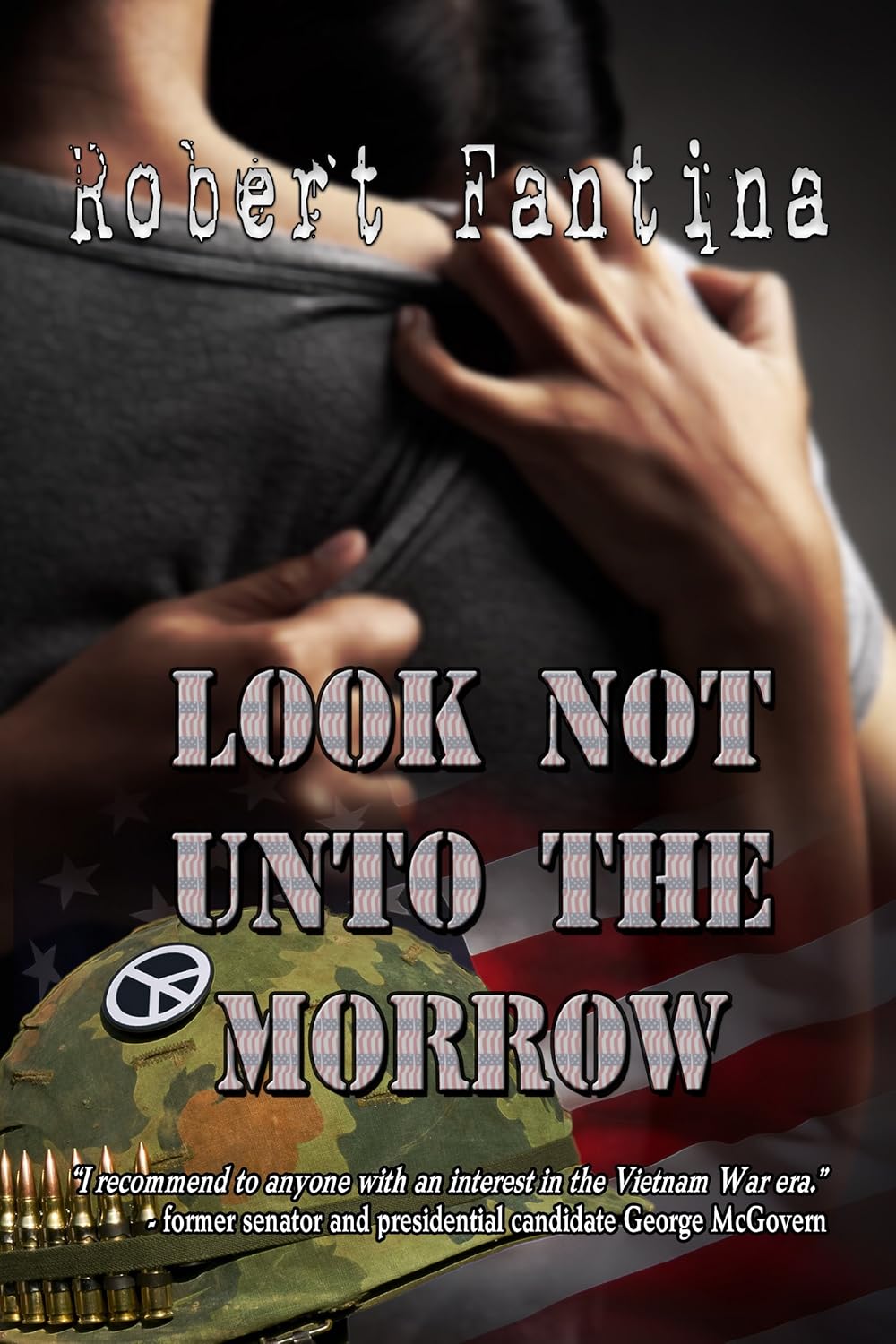
LOOK NOT UNTO THE MORROW by Robert Fantina

In “Look Not Unto the Morrow,” innocence shattered and ultimate redemption are portrayed against the backdrop of the Vietnam War and the turbulent sixties. The story follows the lives of three young people as they experience love and war. Roger Gaines is the promising young college student, drafted into the army and traumatized by his experiences in basic training and Vietnam. Pam Wentworth is the loving girlfriend he leaves behind, who evolves from naive college student, to political activist, to radical anarchist. Michelle Healy is the young woman Roger meets when he returns home, who loves him unconditionally when he can no longer love himself. “I recommend to anyone with an interest in the Vietnam War era.” – Former senator and presidential candidate George McGovern


ON AMAZON

Wednesday, October 9, 2013

DESERTION and THE AMERICAN SOLDIER 1776-2006 by Robert Fantina

Military desertion, its reasons and consequences, are not commonly known in America. In most cases, the reasons soldiers desert are inherent in the military system itself. The author investigates those reasons, from the American Revolution to the Iraqi occupation, and describes the government's often-brutal response to deserters.
Desertion and the American Soldier: 1776 2006 is a history and analysis of military desertion from the Revolutionary War to the Iraqi Occupation. The main topics consist of the following:
The political, economic and social conditions of each time period;
The government's continued insistence on linking desertion with cowardice, despite extensive evidence to the contrary, and
The motivations for desertions.
Despite the US government's continued insistence on linking desertion with cowardice, the motivations for desertion are many and complex, and are either rooted in or encouraged by military policy. This book describes the official policies on desertion that were in force during each conflict and how they were generally implemented; problems in the military justice system; and the motivations for desertions. Comprehensive data and interviews with deserters are included.
Deserters from the US military have generally been referred to as cowards and traitors. This is a significant deception and one that has been accepted for generations. If cowardice and betrayal are not, in fact, the motivating factors for the majority of those who illegally depart from the US military, the question must be asked: Why do they desert? Are the issues that caused soldiers to flee to Canada in 2006 the same as those that caused Union soldiers to leave campaigns in Richmond, Virginia and return to their homes in the north? If not, how have the motivations evolved? What, exactly, causes a soldier, sometimes with a history of battle campaigns, to say enough'?
Most of the causes of desertion are inherent in the military system itself, and this is carefully detailed within this book. Through the use of the government's own studies and statistics throughout history, along with information from other sources, the problems of the military system that cause desertion are detailed.
Along with the reasons for desertion, the government's changing response to it is discussed. Various forms of what can only be classified as torture have often been implemented, with either tacit or open approval by the US government. The author suggests that the government's response to desertion is simply a political tool to not only keep soldiers in the ranks, thus helping to further the country's goals (whether honorable or not), but also to keep the average citizen behind those goals. While the tactics of so doing have advanced through the last two centuries, the purposes have changed little.

www.amazon.com Desertion American Soldier

Image of Robert FantinaRobert Fantina is an activist and journalist, working for peace and social justice. While living in the U.S., he actively supported gun control, and opposed the war in Iraq, prior to and following the U.S. invasion of that country. Shortly after the 2004 presidential election he moved to Canada. While living in Whitehorse (Yukon Territory), he wrote 'Desertion and the American Soldier: 1776 - 2006.'
He is also the author of the novel, 'Look Not Unto the Morrow,' a Vietnam-era, anti-war love story.
His forthcoming book, available in November of 2013, is titled, 'Empire, Racism and Genocide: A History of U.S. Foreign Policy'.
He is currently active in supporting the human rights struggles of the Palestinian people.
Mr. Fantina now resides in Kitchener, Ontario. Visit his web page at RobertFantina .com

Saturday, October 5, 2013

Is History the Agreed-Upon Lie? by ROBERT FANTINA

     One would think that certain historical facts are simply that: facts. Yet within those facts, there is often much interpretation. There is, for example, no question that Christopher Columbus arrived on the North American continent in 1492. However, it is erroneous to say that he ‘discovered’ America, since millions of people were already living on the continent. Yet he is looked up to as a great hero who ‘discovered’ America. The other facts, including that he was a slave trader, only looking for a quicker route to India to improve the profitability of his businesses, are somehow not considered.

     Other information presented as facts are simply fabrications; oh, there may, somewhere, be a germ of truth in them, but mostly, they are simply lies. U.S. history is replete with them; they are taught in public schools, and accepted with little question by most of the citizenry.

     A look at just a few is informative.

·         On August 2, 1964, the U.S. destroyer Maddox was on an espionage mission in the Gulf of Tonkin, off the coast of Vietnam. Tensions were already high in the area, as the U.S. attempted to prevent the entire country from coming under the Communist government in the north. The Maddox reported that it was fired upon and that it responded, sinking one Vietnamese torpedo patrol boat. Two days later, instruments on the Maddox indicated that it was under attack again. The Maddox and its sister ship, the C. Turner Joy, fired back, with assistance from U.S. air power.

Yet within a day, the captain of the Maddox concluded that there might not have been any attack at all; why the instruments on the ship indicated that there had been was not explained. James B. Stockdale, the pilot of a Crusader jet that undertook a reconnaissance flight over the gulf that evening, was asked if he saw any North Vietnamese attack vessels. “Not a one,” he said. “No boats, no wakes, no ricochets off boats, no boat impacts, no torpedo wakes – nothing but black sea and American firepower.”

So there was no attack on the Maddox. Yet this non-event was seen by Congress as aggression against the United States. The so-called ‘Gulf of Tonkin resolution’ was passed, giving President Lyndon Johnson a blank check to escalate the war, which continued for over a decade, killed over 50,000 Americans and between 1,000,000 and 2,000,000 Vietnamese, nearly destroyed the U.S. economy and brought the U.S. to the brink of revolution. The U.S. grew to be hated and feared throughout the world.

·         Less than forty years later, the fear of Communism had faded, but the U.S. needed a new enemy. There must be some way to continue the lucrative business of defense contractors, and enable the U.S. to arrange world affairs to its liking. So terrorism replaced Communism as that which was to be feared and defeated. And in many ways, terrorism is a much better target, since it is hard to define, and when it is defeated is anybody’s guess.

So in 2002, President George Bush proclaimed to the United Nations, Congress and the world that Iraq had weapons of mass destruction, and presented an imminent threat to the U.S. A skeptical United Nations sent weapons inspectors to Iraq, and that country’s leader, Saddam Hussein, provided unprecedented access to any requested sites. They found no weapons of mass destruction. Most of the U.S.’s allies were satisfied that the inspections were taking place, and if there were such weapons to be found, the inspectors would find them. This, however, was not good enough for Mr. Bush. He ‘knew’ that Iraq had these weapons, and as a result, the national security of the United States was in jeopardy. He ordered the U.N. to recall its inspectors, so he could invade.

Following a decade-long war and a brutal occupation by the United States, which nearly threw Iraq into civil war and opened up hostilities among groups that had long lived in peaceful, if uneasy, coexistence, no weapons of mass destruction were ever found. Yet following the invasion and the quick overthrow of the government, Mr. Bush ordered that the oil refineries and associated businesses be protected, as crowds looted museums and universities. In the ensuing decade, estimates of Iraqi deaths range from 100,000 to 1,000,000, and over 4,000 U.S. soldiers died. Countless others returned with horrendous injuries.

The lies the U.S. tells its citizens do not always involve war, although all its wars have been built on lies. The U.S. belief in the pilgrims, arriving at Plymouth Rock and finding an uninhabited land, only awaiting their arrival to use the rich natural resources they found there aplenty, is another myth, long and diligently perpetrated. The unspeakable genocide committed against Native Americans, as their land was brutally stolen from them, has been documented by countless sources, yet is not taught in public schools.

Two-term president Andrew Jackson, considered a hero of the Mexican-American war, confiscated (read: stole) 23 million acres from the Creek nation, and then sold most of it to his fellow-slave owners, keeping a large amount for himself.

Many slaves who escaped bondage in Georgia and Alabama found homes with the Seminoles in Florida. Over a period of generations, their descendants established a peaceful farm community deep inside the territory. Prior to his election as president, Mr. Jackson invaded with an army of southern whites, attacked the community and killed 270 men, women and children. He then took the captured survivors to Georgia and Alabama, and gave them to anyone claiming to be descendants of the ‘owners’ of the original runaways.

Such atrocities were not unique to Mr. Jackson. Other generals, considered national heroes with roads, buildings and airports named in their memories, were also guilty of horrendous crimes.

But why think about such things? Isn’t the United States the world’s beacon of peace, freedom and democracy? Think of the wonders it has done in Iraq and Afghanistan, and now, as this is written, think of the many advantages that drone strikes are bringing to Pakistan, Yemen, and other places around the world. So what if some innocent men, women and children are killed? Being killed by a U.S. drone strike is not quite as bad, after all, as being killed by an evil dictator, is it? And while it is a well-known fact that U.S. citizens suffer, bleed and die, citizens of other nations are accustomed to such horrors, so they don’t mind them quite as much. A Pakistani mother, seeing her five-year-old daughter blown to bits by a U.S. drone, doesn’t feel the same about her loss as a U.S. mother would feel, right?

     This is the illustrious history of the United States: lies, war, murder, genocide. Tragic and criminal as it is, it is compounded by the citizens’ lemmings-like adherence to the party line. The facts are there; the trouble is getting people to face them.


Robert Fantina is an author and activist for peace and international human rights. A U.S. citizen, he moved to Canada following the 2004 presidential election. He has written about military desertion from the United States in his book Desertion and the American Soldier, and has also written about the impact that war has on individuals, in his novel, Look Not Unto the Morrow, a Vietnam-era, anti-war story. His writing appears regularly on Counterpunch.org, Warisacrime.org, and other sites. Mr. Fantina resides near Toronto, Ontario.


Friday, October 4, 2013

A Smidgen of History at the ToiBox

        I don’t read a lot of historical fiction, but what I have read, I have found to be quite fascinating. Historical fiction, when done well, blurs the lines of truth and myth to the point where the reader is left wondering, “What if?” While I also do not write historical fiction, I do look into the past to give my stories depth, particularly in my upcoming book, Eternal Curse: Giovanni’s Angel.

Like many authors, on the road to publication, I’ve picked up the habit of blogging. My website and blog are called the ToiBox, and that is where I share my toy box of words (#thetoiboxofwords). On my blog I discuss many aspects of my writing and promote my books, as well as share a bit of myself so people have a chance to get to know me.
In my efforts to be all inclusive, there are times when I look back at history to see where I’ve come from and how I got to where I am now. Since my book, Eternal Curse: Giovanni’s Angel is a story that spans many years, I sometimes have an opportunity to share the research and development of that story from a historical point of view, even if it is quite rare. Even though I like the freedom of impossibility that the genre of fiction provides, I do also respect a sense of reality and truth. I have no intention of going back and rewriting history in my stories, so I make an effort to be historically accurate whenever possible.

I guess the only thing I need to concern myself with now, Is How Much of History Can We Trust (see my post from Saturday, September 27, 2013, for reference) 


****

To learn more about Toi Thomas and Eternal Curse: Giovanni’s Angel, please visit these links:

Wednesday, October 2, 2013

Fact, Fiction, Doctrine, Oh My!

      I’d like to take a moment and step away from historical facts. There is another side to history and myths that often cause conflict in the world of writing. As I’ve already pointed out in my previous post, sometimes history isn't always right and sometimes the facts are not what they seem, and then there is a matter of doctrine. Tossing doctrine into history is whole other can of worms I don’t think that I’m quite ready to tackle, but fiction vs. doctrine is a matter of constant discussion concerning my book, Eternal Curse: Giovanni’s Angel. Below is an small piece I wrote on the matter, which is now published in my ebook, 40 Days and Nights of Eternal Curse.

****
Fiction vs. Doctrine
Doctrine is one of those words that you don’t often hear in everyday conversation, but once you’ve heard it used in a sentence you pretty much understand its meaning. Not wanting to take anything for granted, I will put this notion aside briefly to explain what doctrine is. Doctrine is a set of rules and or principles that are taught as part of a belief system, whether it be philosophical, religious, or political.
Fiction isn’t nearly as complicated. For me fiction is anything that the mind can image. There is so much reality surrounding us in modern society that started out as pure fiction in someone’s imagination. Fictions is make-believe, it’s fantasy, it’s what if and how about this. I like to tell fictional stories because it leaves open limitless possibilities. While much fiction is influenced, inspired by, and even derived from factual events, the very nature of the media keeps you from being forced to accept the limitations of reality and facts.
The story of Eternal Curse: Giovanni’s Angel is a fictional story with a basis in one particular religious doctrine. I’m obviously influenced by the things I know and have been exposed to throughout my life. Fiction in story telling is like painting a picture; you can make the picture look however you want, but it may still be interpreted in many different ways.
I hope that those who have an appreciation for Judeo Christian philosophy will not get too bogged down by my lack of detail and accuracy; and will instead just enjoy the story. For those unfamiliar with Judeo Christian philosophy, I suspect they will have no problem just enjoying the story, as long as they don’t read it trying to find something that isn’t there. - Day 38 complete.

****

40 Days and Night of Eternal Curse is a FREE ebook with promo code GW22H at Smashwords.com until the end of August 2014, however, if you wish to purchase a paperback copy of this book, please click on the following link. *Also, if you’re not Smashwords savvy and would like to purchase a Kindle copy of this book for $1.59, click on the link provided.

With the release of Eternal Curse: Giovanni’s Angel, at least one more update is planned for this ebook. Click the image for an introduction and visit the Eternal Curse Series tab for a description.


40 Days and Nights of Eternal Curse Copyright © 2012 Toinette Thomas


****

To learn more about Toi Thomas and Eternal Curse: Giovanni’s Angel, please visit these links: